


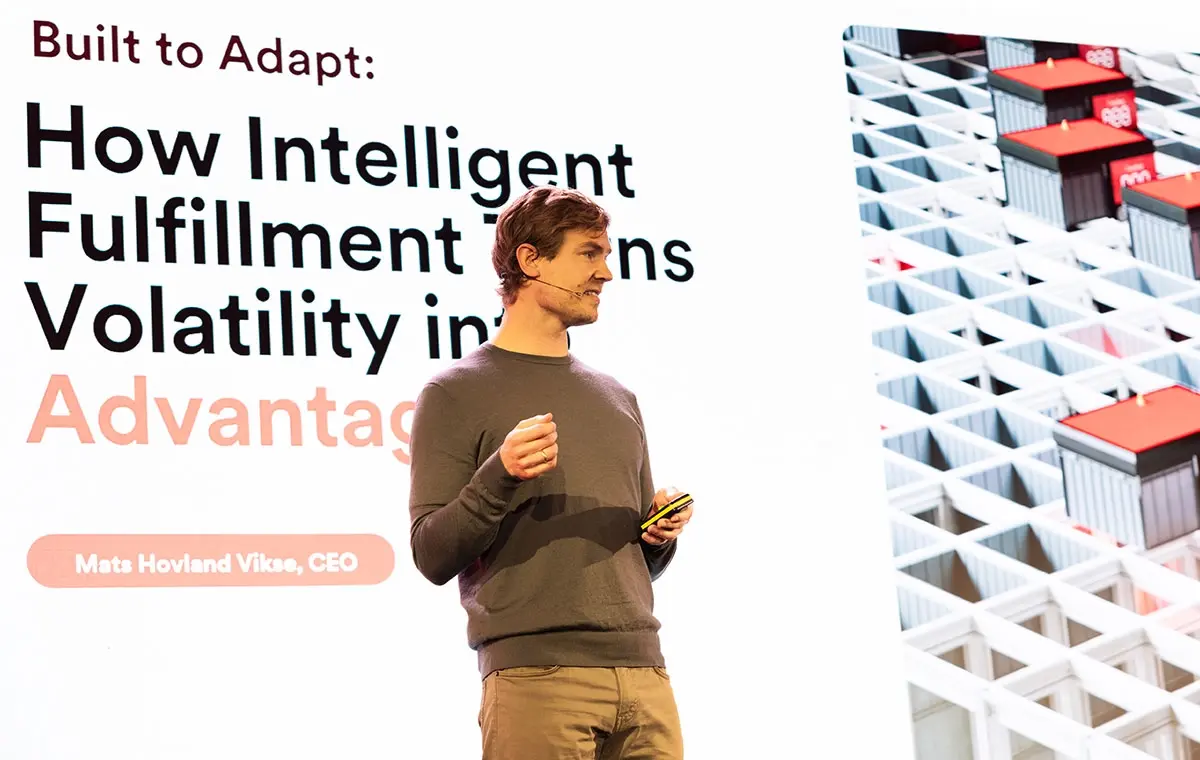
In his opening keynote during AutoStore Arena 2026 in Europe, CEO Mats Hovland Vikse made it clear that supply chain volatility isn’t going away. But it doesn't have to be only a source of risk. It can also reveal opportunities to build a more adaptable operating model.
Supply chain volatility has become a permanent operating condition. These days, demand can move faster than a fulfillment network can redirect inventory, while changes in trade, technology, customer expectations, and operating conditions can outpace the infrastructure built to accommodate them. The plan you have today might be commercially sound. Tomorrow, it might be operationally unworkable.
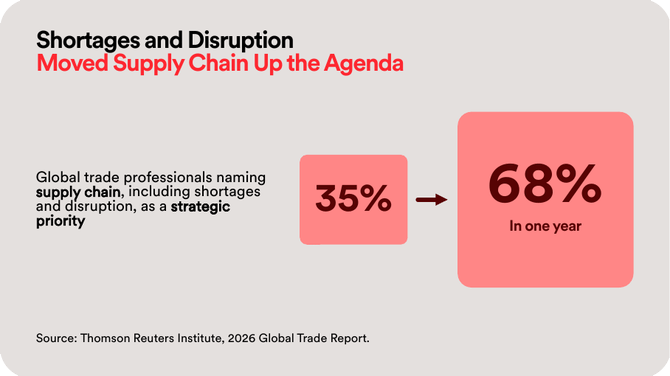
These pressures have moved supply chain disruption higher on the business agenda. In the Thomson Reuters Institute’s recent Global Trade Report, the share of global trade professionals naming supply chain, including shortages and disruption, as a strategic priority nearly doubled in one year, from 35% to 68%.
Their focus is also moving beyond day-to-day inventory and logistics optimization toward systemic resilience. But resilience built only on playing it safe has a cost of its own. A business that cannot fulfill a new pocket of demand may lose profitable growth even while maintaining existing service commitments. When demand shifts, fulfillment capacity determines whether a company can take advantage of the opportunity before it disappears or moves to a competitor.
Cost discipline that funds growth
Logistics decisions are no longer judged only by how effectively they protect margin or reduce operating cost. They increasingly influence where a business can grow, which customers it can serve, and how quickly it can respond when market conditions change.
That shift is changing how successful businesses manage costs. Cost discipline is not simply a cutback exercise. Leading organizations are making costs and trade-offs visible across the enterprise, so they can release capital for future differentiation.
Instead of applying the same percentage reduction to every budget, a zero-based approach starts by asking which activities and resources are required to deliver the desired outcome. Existing spending must earn its place rather than being carried forward automatically. Applied to fulfillment, that means looking beyond isolated warehouse savings. A decision that lowers cost in one part of the operation may constrain service, flexibility, or growth elsewhere. The stronger approach is to understand cost-to-serve across customers and workflows, then direct resources toward the areas where they create the greatest commercial value.
The good news is that although turbulence can expose the limits of an operating model, it can also create momentum to build a better one. The question is no longer simply whether the business can withstand disruption. It is whether the operation can redirect resources quickly enough to create value while the opportunity is still available.
The few, the proud, the ‘anti-fragile’
At AutoStore Arena in Chicago earlier this year, we argued that resilience no longer means simply adding more inventory, redundancy, or backup capacity. It means being able to keep performing while conditions change.
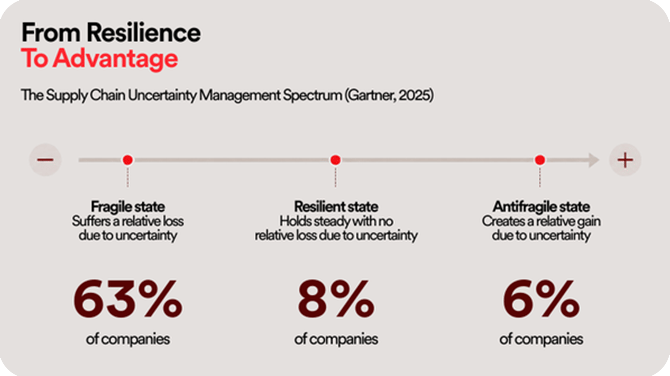
Gartner's idea of antifragility takes that one step further. Resilience remains the foundation, but antifragile businesses don't just preserve value during uncertainty; they gain value because conditions change. That could mean serving demand a less adaptable competitor can't reach, without letting the risk strategy destroy margin elsewhere.
Few companies get there. According to Gartner's analysis, 63% of supply chains are fragile, 8% are fully resilient, and only around 6% are antifragile.
Antifragile organizations don't depend on one supposedly perfect plan. They use experimentation, probabilistic planning, and stress testing to understand how different conditions affect available options. They also connect network design with sales and operations planning so resource decisions reflect both operational constraints and commercial priorities.
This mentality raises the bar for how these companies judge performance. Adherence to an original "safe" plan can lead to a missed opportunity or reward an allocation that no longer makes economic sense. They measure success through how well resources create value, not simply whether the original plan was followed.
The shift to an autonomous mindset
Antifragility depends on more than producing a wider range of plans. The operation must also be able to recognize when conditions have changed, evaluate the available responses, and act before the opportunity disappears. This is where the distinction between automation and autonomy becomes important.
Automation has transformed logistics by performing predefined work reliably, repeatedly, and at scale. That foundation remains essential. But automation is designed to follow established instructions, and those instructions may cease to support the desired outcome when conditions change. A system can execute yesterday’s priorities efficiently while today’s most valuable orders wait.
An autonomous mindset raises the ambition. Rather than only executing predefined tasks, an autonomous operation can sense changing conditions, evaluate decisions within defined guardrails, and adapt its actions toward an agreed business outcome.
As Gartner put it, “The automation mindset works when the world is stable. The autonomous mindset works because it isn’t.” This does not mean handing every supply chain decision to AI. It means deciding which actions can safely be delegated, which information an autonomous system requires, and where people must retain authority.
Gartner recommends balancing exploitation and exploration. Exploitation applies AI to existing processes to create value today, while exploration asks how the operation itself could work differently in an autonomous future. Businesses still need to improve today’s operation while developing the decision structures they will need tomorrow.
Autonomy has to work in the physical world
Autonomy is not only an AI or software challenge in fulfillment. It is also a physical one. Software may identify available inventory at another site, for example, while the physical operation remains unable to retrieve or process it within the required window. Intelligence creates commercial value only when the operation can act on it and the underlying data can be trusted.
This is where Intelligent Fulfillment becomes relevant. AutoStore combines a standardized physical system with connected software and intelligence built around live operational data. A consistent system architecture provides a common data foundation across the lifecycle, from design and simulation to operation and continuous optimization. That helps operators understand changing conditions, improve how work is prioritized, routed, and performed, and introduce autonomy step by step, within guardrails that people define. Autonomy without shared objectives and clear guardrails can make an operation faster without making it better.
At AutoStore Arena, the Fall Product Announcement extended this connection beyond storage and retrieval into workflows such as case handling and robotic picking. But the larger point is not any individual product. Antifragility requires intelligence that can influence what happens in the physical operation, not simply describe it.
When demand shifts unexpectedly, the goal is not to protect the original plan at all costs. It is to protect the outcome that matters most. The organizations that gain an advantage from volatility will not necessarily be the ones with the most sophisticated forecasts, but the ones that can coordinate the right response when conditions change.