/2025-02%20AutoStore%20Logo%20Landscape%20(red%20white).png?width=175&height=31&name=2025-02%20AutoStore%20Logo%20Landscape%20(red%20white).png "2025-02 AutoStore Logo Landscape (red white)")
/2025-02%20AutoStore%20Logo%20Landscape%20(red%20black).png?width=175&height=31&name=2025-02%20AutoStore%20Logo%20Landscape%20(red%20black).png "2025-02 AutoStore Logo Landscape (red black)")
.svg)


Kitting: How And When To Use It
Kitting is a powerful process that simplifies warehouse operations by grouping individual items into preassembled kits, ready for use or shipment....
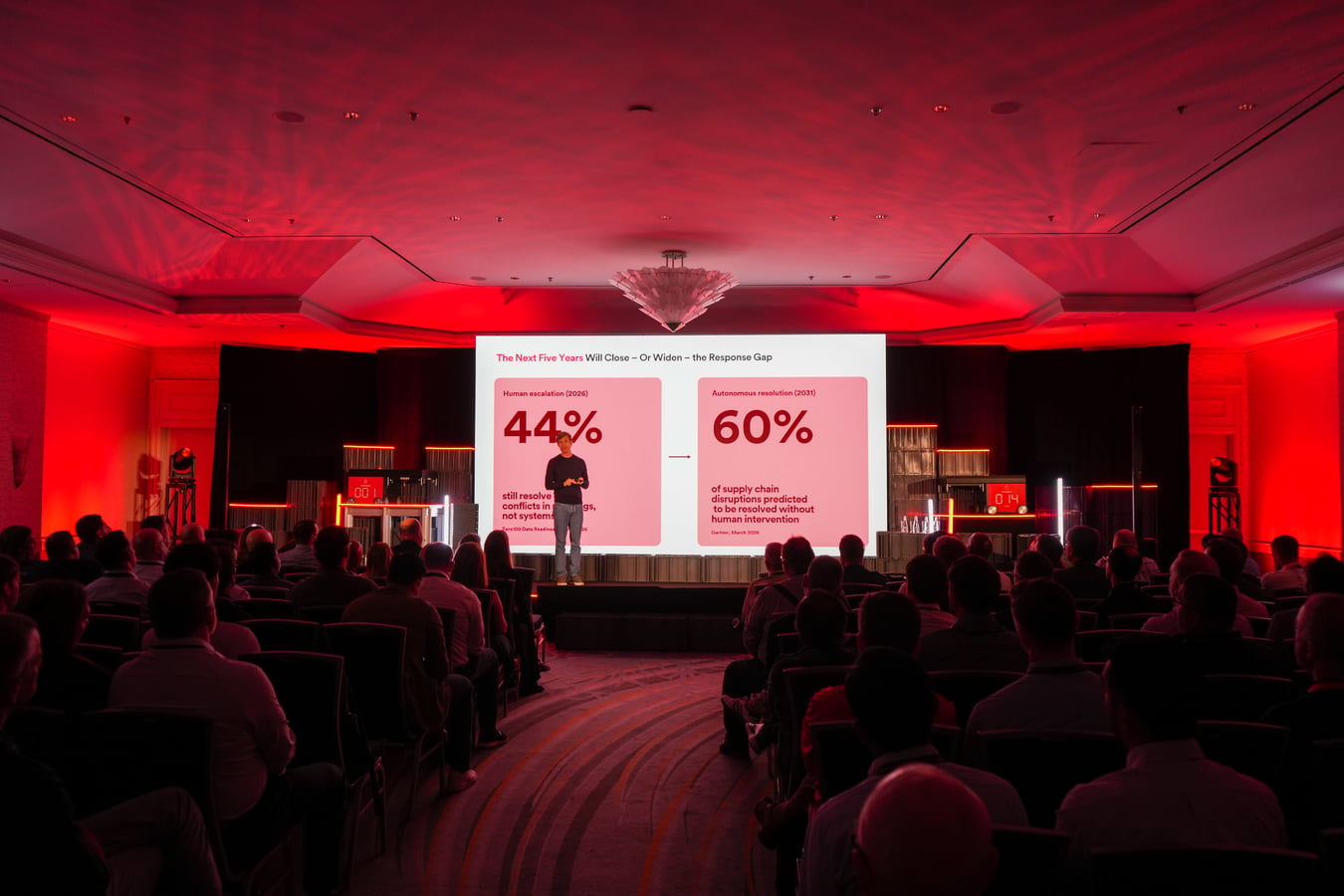
In his opening keynote during AutoStore Arena 2026 in Chicago, CEO Mats Hovland Vikse set out a challenge for every operator in the room: the next shock is no longer the real threat. The speed at which it reaches your customer is. This article expands on the keynote, drawing on research from supply chain intelligence firm Zero100.
Volatility has always been part of running a supply chain. Recessions, demand swings, weather, labor disputes. Leaders have managed through all of it for decades. What has changed is the speed at which it now reaches operations and the customer.
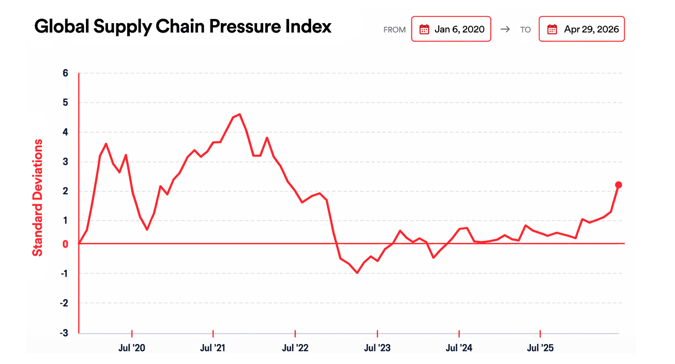
We saw this clearly in April 2026, when the Federal Reserve Bank of New York's Global Supply Chain Pressure Index rose to its highest level since July 2022 and recorded its largest single-month jump since the onset of the pandemic. A disruption that might once have unfolded gradually across several planning cycles arrived almost at once.
Two forces explain why speed matters more now.
The first is that shocks themselves have become faster and more systemic. A disruption in a single maritime chokepoint, such as the Strait of Hormuz or the Panama Canal, no longer stays local. It reroutes global freight overnight, adds ten to fourteen days of transit, and ripples through energy costs, insurance premiums, and carrier capacity within days.
The second is that the system has far less slack to absorb it. After the wild swings of 2020 to 2022, U.S. inventory-to-sales ratios have settled back to some of their leanest levels on record, reaching 1.31 in April 2026, close to pre-pandemic efficiency. In practice, that means companies are holding only about 1.3 months of stock relative to sales, and the lower the number, the smaller the cushion when something goes wrong. And most have not simply gone lean, they run deep buffers on a handful of critical items and minimal stock on everything else. So, when a shock hits the lean part of the network, which is most of it, almost nothing stands between the disruption and the customer.
Together these forces make the change structural rather than temporary. Analysts at Zero100 describe a clear shift from periodic planning to continuous responsiveness, driven by conditions that now change faster than people can keep up with. In a traditional model, when something shifts — a delayed shipment, a demand spike, a supplier going dark — a planner has to go in and redo the plan: pull the latest numbers, work out what moves where, and reset schedules across the network. That used to be manageable within a planning cycle. Now the conditions change again before the plan is even finished. This is the new baseline.
That shifts the focus. Not to the disruption itself, but to where it lands, and whether the rest of the operating model can keep pace.
The second pressure comes from technology, and it is new too. We have more data, more automation, and more AI than at any point in the industry's history, and the pace of that change is now a force of its own. Yet most decisions still move at the speed of a meeting.
That is the gap. Disruptions surface at machine speed, but the response still travels through fragmented systems, manual coordination, and long approval chains. Visibility has improved enormously. Deciding what to do next, and making it stick across planning, logistics, and operations, has not.
The Zero100 Data Readiness Survey 2026 puts a number on it. When different functions see conflicting data for the same decision, 44% still resolve the conflict in a meeting rather than by a system.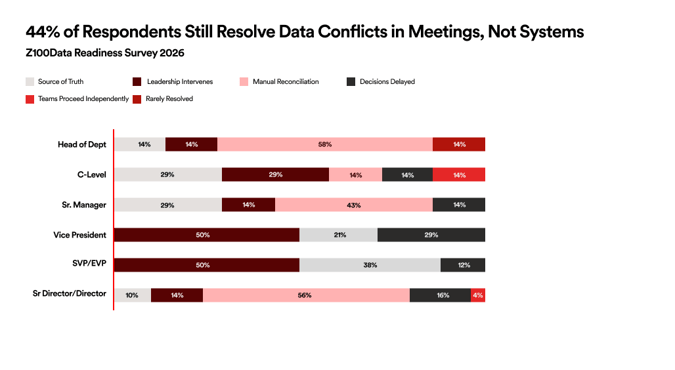
And this becomes even more pronounced higher up the organization. The more strategic the decision, the more likely it is settled by senior people in a room rather than by a trusted system. The data exists — it just doesn't line up into a single, shared answer on its own.
This is the gap that has to close, because the bar is about to rise. Gartner predicts that by 2031, 60% of supply chain disruptions will be resolved without human intervention. That is only five years away.
The shock already arrives at machine speed. The response still does not.
But machine speed has a catch. A decision is only as good as the data underneath it, and speed without that foundation is not resilience. It is just a faster way to be wrong.
This is why the 44% finding matters more than it first appears. Teams meet because the data does not agree, and someone has to reconcile it before anyone can act. The meeting is a workaround for data that has not converged. Automate on top of that and you do not remove the problem. You scale it.
So, the work before autonomy is unglamorous but decisive. The data has to be trusted, so teams stop relitigating whose number is right. It has to be consistent, so planning, logistics, and operations work from the same picture. And ownership has to be clear, so a decision can be executed without a chain of escalations. Zero100 analysts put it plainly: faster decision cycles only improve outcomes when they rest on trusted data, clear governance, and aligned processes.
That is the real threshold between today and 2031. Not whether a system can act on its own, but whether the data is good enough to let it.
This changes what resilience actually means. For a long time it meant protection. More inventory, backup capacity, redundancy, fallback plans. Those things still matter, but on their own they are expensive and slow. A buffer can only absorb a shock it was sized for. It cannot decide what to do when conditions move outside the plan.
So here is the new definition. Resilience is the ability to keep performing while conditions change.
That changes the questions that matter. Not whether you hold more stock, but whether you can use the stock you already have — accurate, accessible, and in the right place when priorities shift. Not whether you can see a problem, but whether you can act on it before it reaches the customer. Zero100 describes leading organizations the same way: the ability to sense and act faster, to shift plans and resources as conditions move, to keep service steady even as everything around it shifts.
Visibility tells you what is happening. Resilience is what you do next.
So, what does it take to keep performing while conditions change? It comes back to the foundation the whole system runs on.
Every AutoStore system is built on the same architecture, which means the data it produces speaks one language. Across more than 90,000 Robots and almost 2,000 live systems worldwide, that turns millions of daily operations into one compounding source of intelligence, the kind of trusted, converged data that fast decisions depend on. The more the network runs, the better every system in it gets.
That’s why we believe the next era of resilience will be defined less by how much buffer a company holds, and more by how quickly its fulfillment system can sense, decide, adapt, and execute.
The next shock is already on its way. The only question that still matters is whether your operation can decide faster than it arrives.
Kitting is a powerful process that simplifies warehouse operations by grouping individual items into preassembled kits, ready for use or shipment....

As disruption becomes a constant, the ability to sustain throughput under pressure is emerging as a critical competitive advantage. Drawing on...

What does fast moving consumer goods (FMCG) really mean? Get the answer in this short blog and learn how you can stay ahead with the right strategies...

RFID (radio frequency identification) has emerged as a game-changing technology within inventory management, offering a smarter way to track and...