5 min read

How AI in CubeControl™ Unlocks Hidden Performance in Large AutoStore Systems

How AI in CubeControl™ Unlocks Hidden Performance in Large AutoStore Systems

Table of Contents

In large, high-density AutoStore systems, there are often opportunities to further enhance throughput, especially during peak operations. Read on to see how CubeControl tackles Grid complexity head on, optimizing Robot movement using AutoStore Intelligence to unlock the high level of performance that’s already inside your system.

As AutoStore systems scale, maintaining consistently high performance across increasingly complex operations becomes more challenging to fine-tune manually. Even when hardware performs exactly as designed, there are opportunities to further optimize how the system coordinates Robot activity, especially during peak periods.

The opportunity isn’t about changing the hardware. It’s about how effectively the system orchestrates complexity.

In modern AutoStore Grids, especially large, high-density ones, hundreds of Robots operate simultaneously in a tightly coordinated environment. While these systems already perform at a high level, fine-tuning how that interaction is managed can unlock additional gains.

The next level of performance comes from how intelligently the software coordinates movement and flow across the Grid, a role CubeControl™ is precisely designed to play.

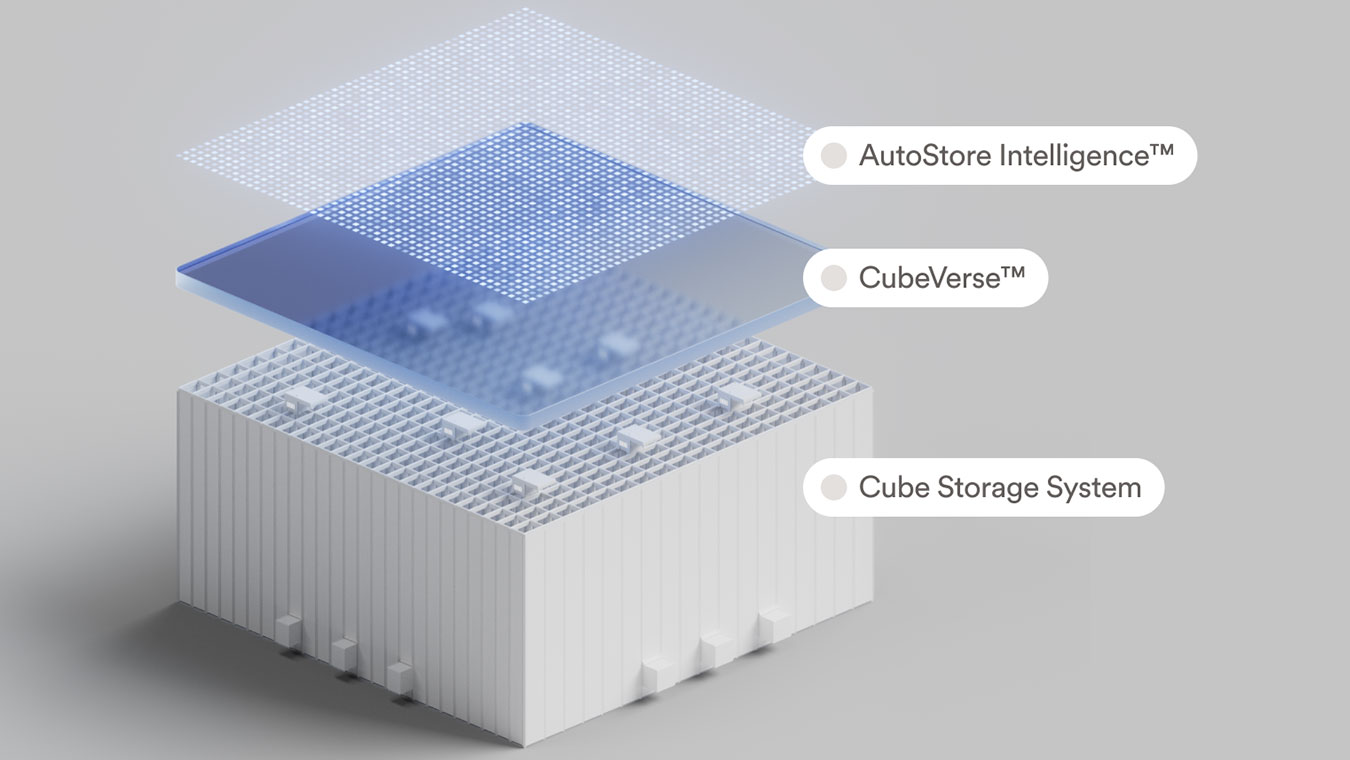
CubeControl is the software layer that operates and coordinates the entire AutoStore system. Router™ software determines where individual AutoStore Robots go in the moment. CubeControl, by contrast, is the full operating system that runs the Grid. It governs Robot behavior rules, routing logic, sequencing at Ports, and how traffic flows across the entire system.

That distinction is critical. Meaningful optimization requires visibility across the whole Grid. Improving traffic flow in one area can easily create congestion elsewhere if the system is optimized in isolation.

What ‘AI in CubeControl’ Actually Means

In practical terms, the AI layer in CubeControl optimizes how Robots move through an AutoStore Grid without changing a single piece of hardware.

It analyzes how AutoStore Robots behave in a specific system, identifies inefficiencies that are difficult to see manually, and adjusts how routing is handled to improve overall flow. The outcome is higher throughput and shorter Bin wait times from the system customers already have.

Importantly, this isn’t generic optimization applied across all sites. Each AutoStore system is different. Grid layout, Robot density, operational profile, and peak patterns all vary. The role of AI is to personalize how CubeControl manages Robot behavior for a specific Grid, rather than relying on “one-size- fiits-all”` settings.

The Hidden Cost of Congestion in Large Grids

In large, high-density environments small improvements can deliver meaningful gains.

As systems scale, coordination between Robots becomes more dynamic, especially during peak periods. Small shifts in traffic flow and task sequencing can influence how efficiently the system utilizes its full capacity.

These patterns aren’t always immediately visible. With hundreds of Robots operating simultaneously, performance is shaped by the interaction of many small decisions across the Grid. This level of complexity goes beyond what can be easily analyzed or fine-tuned manually.

While the system consistently delivers strong performance, these dynamics become most noticeable during peak operations when optimizing every available resource has the greatest impact on throughput and efficiency.

What the AI Actually Does

CubeControl's AI feature enhances system performance through two tightly linked capabilities:

1. Personalized Routing Parameters

Rather than relying on generic settings, the AI optimizes CubeControl’s routing parameters specifically for a Grid’s layout, density, and operational behavior. Every site is different, and the AI identifies the parameter configuration that best matches that reality.

This is not guesswork. The system evaluates how Robots move under load and tunes the rules that govern their behavior accordingly.

2. ‘Smart Highways’

“Smart Highways” are AI-guided “fast lanes” through the Grid.

In dense systems, Smart Highways introduce clearer structure to Robot movement, helping guide more efficient and predictable flow across the Grid. Smart Highways define preferred routes that reduce unnecessary cross traffic and create more predictable flow.

Together, routing personalization and Smart Highways attack the same problem from different angles. One adjusts the rules of movement. The other reshapes the paths Robots take.

How CubeControl Works

CubeControl runs in the background of the AutoStore Simulator™ software, which is used to forecast system performance. During an optimization, CubeControl initiates a series of trial runs, and the built-in AI layer evaluates a large volume of simulation data to refine backend parameters, leading to improved planning and Robot coordination and stronger overall system performance.

CubeControl - 1
 
Completed simulation runs are compared to evaluate how different parameter sets impact overall system performance.
CubeControl - 2
 
Hundreds of parameter combinations are tested across staged simulations to identify the most effective configuration.
CubeControl - 3

System conditions such as Robot count and Grid density are analyzed to surface opportunities for performance improvement.
CubeControl - 4
 
A final verification run confirms gains, highlighting measurable improvements in throughput, efficiency, and wait times.
CubeControl_highways-1
 
Grid-level traffic patterns reveal optimized “highways” that reduce congestion and improve Robot routing efficiency.
CubeControl - 6


Proven parameter sets can be applied to new simulations or exported for deployment in live systems.

AutoStore operators can either re-test CubeControl's recommendations or load them into CubeConsolefor deployment on a live Grid. As part of this process, the AI also identifies and refines the “smart highways” that guide Robot traffic along the most efficient routes, helping to reduce congestion and Bin wait times.

How the AI Knows a Change Is Better

Every optimization is validated through simulation before anything is applied to a live system.

The AI runs inside AutoStore’s simulation environment, evaluating potential routing and highway configurations against concrete performance signals: throughput, Bin wait time, and congestion levels. Only recommendations that show measurable improvement in simulation make it through.

If a proposed Smart Highway doesn’t improve performance, it’s discarded. The system does not force changes simply for novelty’s sake.

This simulation based validation is what allows AI driven optimization without introducing operational risk.

Where the Impact Is Largest and Where It Isn’t

AI-based traffic optimization delivers the most value in large, high density Grids, particularly those with recurring throughput peaks.

At this scale, the number of possible Robot interactions is enormous. Manual tuning can help, but it can’t explore the vast combinations and scenarios of how Robots interfere with one another, and under varying load as AI can.

Smaller systems tend to generate less complexity. If a site is operating comfortably within its capacity, the potential gains are naturally more modest. The strongest signal for meaningful impact is a system that is already working hard, producing high Robot density, consistent peak pressure, and visible congestion during busy periods.

Throughput, Bin Wait Time, and Peak Protection

While throughput is often the headline metric, because it maps most directly to business outcomes, it doesn’t exist in isolation.

Bin wait time is the underlying driver. When Bins arrive at Ports faster, flow improves throughout the system. Congestion reduction is the mechanism that enables this improvement. Peak protection is where operations teams feel the difference most clearly.

A system that maintains performance during peak demand is a system businesses can rely on.

In one high-density Grid simulation, AI-driven routing personalization and Smart Highways reduced average Bin wait time from 2.6 seconds to 1.8 seconds. Throughput increased by roughly 7%, from around 26,400 to over 28,300 Bins per hour, using the same hardware.

That result is specific to that system profile. Performance gains vary based on Grid complexity and operating conditions. The broader takeaway is not a universal percentage, but the fact that meaningful gains are often locked inside the software layer.

Trust, Data Isolation, and Customer Boundaries

All optimization runs are based entirely on a site’s own simulation data and Grid behavior. Customer operational data remains isolated within that system.

The broader engineering knowledge AutoStore has accumulated about how Grids behave at scale is embedded in how the AI models the problem, not through sharing customer data between sites. Customers benefit from AutoStore’s experience without compromising data boundaries.

Availability and Rollout

AutoStore Intelligence in CubeControl is being introduced through a phased rollout to ensure that the experience scales correctly and delivers consistent value.

Customers interested in exploring AI driven optimization can signal interest through their AutoStore partner, who coordinates with AutoStore to assess fit and manage engagement.

The Bottom Line

Large AutoStore systems already deliver strong performance at scale, and advances in software are now unlocking even higher levels of efficiency and throughput.

CubeControl addresses that directly. By personalizing routing behavior and creating structured traffic flow through AI, it enables customers to unlock performance already sitting inside their system.

For many high-density Grids, AI is no longer an experimental add on. It’s the practical path to sustained performance, at scale.

Related articles