/2025-02%20AutoStore%20Logo%20Landscape%20(red%20white).png?width=175&height=31&name=2025-02%20AutoStore%20Logo%20Landscape%20(red%20white).png "2025-02 AutoStore Logo Landscape (red white)")
/2025-02%20AutoStore%20Logo%20Landscape%20(red%20black).png?width=175&height=31&name=2025-02%20AutoStore%20Logo%20Landscape%20(red%20black).png "2025-02 AutoStore Logo Landscape (red black)")
.svg)


Revolutionizing Pharmaceutical Warehouses
Explore how AutoStore is revolutionizing pharmaceutical warehouse operations, addressing challenges in storage, efficiency, and regulatory compliance.

As disruption becomes a constant, the ability to sustain throughput under pressure is emerging as a critical competitive advantage. Drawing on insights from AutoStore’s “State of the Warehouse Management and Fulfillment in 2026” report, this blog explores why warehouse leaders are redefining high performance around reliability, resilience, and operational consistency.
For years, warehouse performance conversations revolved around one metric above all others: speed.
How many orders per hour?
How fast can goods move through the system?
How quickly can fulfillment operations scale during peak demand?
In 2026, those questions still matter. But according to AutoStore’s “State of the Warehouse Management and Fulfillment in 2026” report, warehouse leaders are starting to recognize a hard truth: Speed without reliability creates fragility.
The industry’s priorities are shifting accordingly.
Today’s fulfillment leaders are no longer chasing throughput in isolation. They are trying to build operations that can sustain high performance consistently, absorb disruption without collapsing, and adapt dynamically as conditions change. Reliability has evolved from a maintenance KPI into a strategic operational requirement.
That shift reflects a broader transformation happening across fulfillment and supply chain operations. Warehouses are no longer judged only on how fast they move inventory. They’re judged on how predictably they can execute under pressure.
And pressure is everywhere.
Economic uncertainty, labor shortages, geopolitical instability, fluctuating demand patterns, and rising customer expectations have turned disruption into a daily operational reality. The report notes that “supply chain resilience once again tops the list of priorities for fulfillment leaders in 2026.”
In that environment, reliability becomes inseparable from competitiveness.
The report introduces what it calls the “throughput paradox.” Warehouses overwhelmingly recognize throughput as mission-critical, yet many still struggle to achieve high-performing operations consistently.
Ninety-three percent of respondents say higher or faster throughput is either “extremely” or “very” important to their business. Yet only 21% describe their current throughput performance as “great.”
That gap reveals something important.
The challenge is no longer understanding why throughput matters. The challenge is sustaining throughput reliably across increasingly complex fulfillment environments.
This is where many operations run into trouble. Warehouses often optimize for bursts of speed while overlooking the systems-level weaknesses that undermine long-term consistency. A fulfillment operation may perform well under normal conditions but struggle when volumes spike, labor availability changes, inventory patterns shift, or equipment disruptions occur.
The report’s expert commentary captures this tension directly:
“Speed is vital, but it’s only meaningful if it’s consistent, reliable, and able to flex with shifting demand.”
That distinction matters because inconsistent fulfillment creates cascading operational consequences:
Missed delivery windows
Inaccurate inventory visibility
Labor inefficiencies
Higher exception handling costs
Degraded customer trust
In other words, unreliable throughput is expensive throughput.
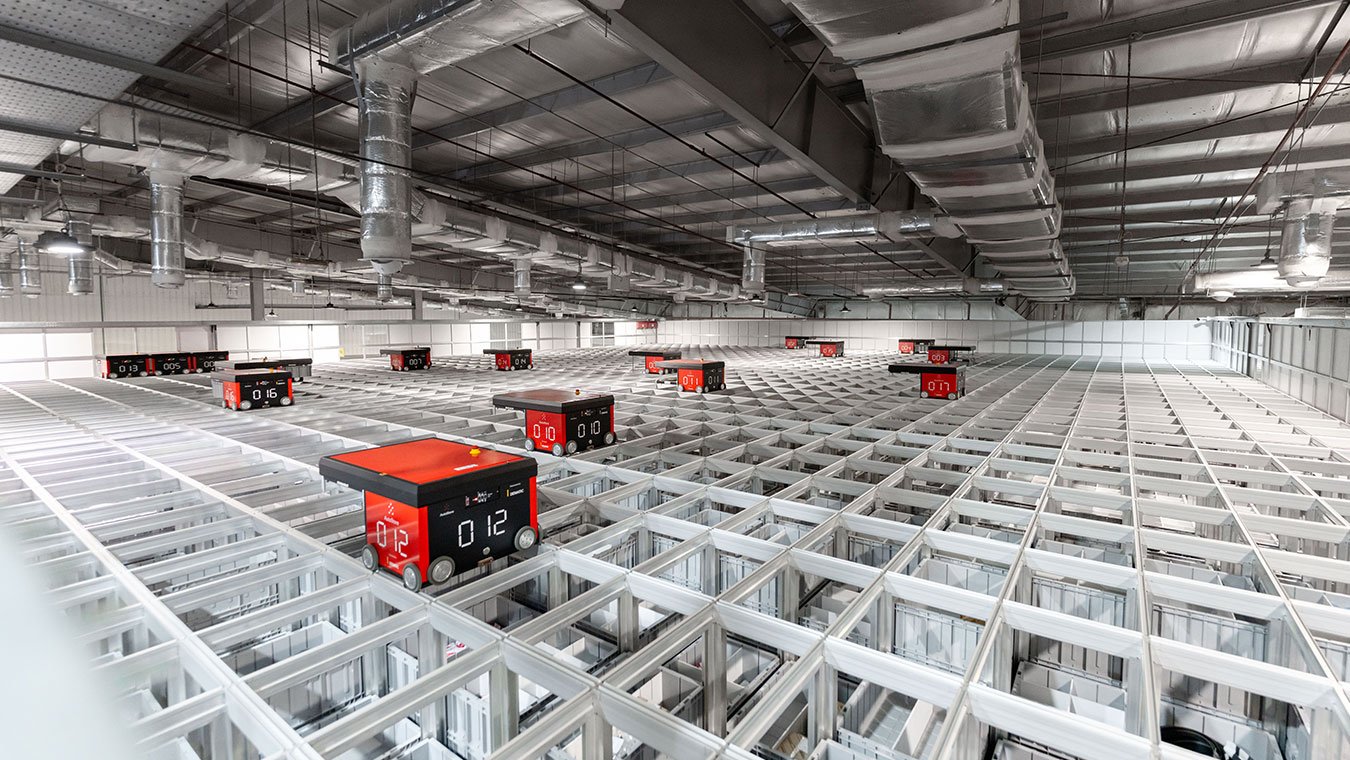
AutoStore’s cube-based automation system is designed for operational continuity, helping warehouses maintain reliable performance through intelligent software orchestration, distributed robotics, and built-in redundancy.
One of the clearest themes throughout the report is that warehouse reliability can no longer be solved through hardware alone.
Historically, automation conversations focused heavily on mechanization like conveyors, robotics, storage systems, and physical infrastructure. But in 2026, that operational reliability increasingly depends on the intelligence layer coordinating those systems.
Integrated software orchestration, real-time operational visibility, and AI-enabled decision-making are all essential.
“Strong system software allows for dynamic routing, real-time adjustments and data-driven decision-making.”
This represents a major evolution in warehouse thinking.
Reliable operations are no longer defined simply by whether machines are functioning. They are defined by how effectively the entire fulfillment ecosystem can detect operational changes, respond dynamically, rebalance workflows, and maintain continuity without human intervention slowing everything down.
That requires a different operational architecture entirely.
Modern fulfillment systems increasingly need to function as adaptive networks rather than static workflows.
The report also highlights how reliability concerns are shaping automation investment decisions.
Among the biggest barriers to automated storage and retrieval system (AS/RS) adoption, respondents cite are complicated implementation processes, onboarding complexity, integration challenges, and “high unplanned downtime and disruption to operations.”
This is significant because it reveals a growing tension inside fulfillment organizations.
Leaders understand they need more automation and more intelligence. But they also recognize that poorly implemented systems can introduce operational risk during deployment and scaling phases.
That concern is valid. As warehouses become more interconnected, operational dependencies multiply. A disruption in one area can ripple quickly across the entire fulfillment process. Reliability therefore becomes less about isolated uptime metrics and more about operational resilience across the full workflow.
That is why implementation strategy is becoming just as important as technology selection itself.
The organizations gaining ground are not necessarily the ones deploying the most automation the fastest. They are the ones building stable operational foundations that can evolve over time without introducing unnecessary fragility.
Perhaps the biggest takeaway from the report is that reliability itself is emerging as a strategic differentiator.
Automation alone is no longer enough. The report explicitly states:
“Automation is no longer a question of ‘if,’ but of ‘how well.’”
That “how well” increasingly comes down to operational consistency.
Can fulfillment systems maintain uptime during demand spikes?
Can workflows adapt without creating bottlenecks?
Can operations scale without introducing instability?
Can warehouses continue executing effectively amid labor shortages, shipping disruptions, and changing inventory conditions?
Those are now the defining questions of warehouse excellence.
The fulfillment leaders pulling ahead are not necessarily the fastest operations in ideal conditions. They are the operations capable of maintaining performance when conditions become unpredictable.
In 2026, reliability is no longer a secondary operational metric It is becoming the foundation of “Intelligent Fulfillment” itself.
Delve deeper into the report's findings by downloading a copy of AutoStore's 2026 State of the Market.


Explore how AutoStore is revolutionizing pharmaceutical warehouse operations, addressing challenges in storage, efficiency, and regulatory compliance.

In this article I will introduce the crucial role of warehouse inventory replenishment in streamlining operations and meeting customer demands.
1 min read
In this article I will introduce the crucial role of warehouse inventory replenishment in streamlining operations and meeting customer demands. In...

Discover how AutoStore can significantly reduce warehousing errors. Dive deep into strategies, challenges, and solutions for an optimized supply...